Opera 7 Review
6th February 2003 · Last updated: 5th October 2016
(Please note that this review is based on the first final release of Opera 7, not later versions, which may have solved many of the problems detailed below.)
It's 2003 and we still don't have a browser that supports all CSS2. What Opera 7 does is give us a brand new rendering engine - the one in version 6 was scrapped. It also has a host of new features, but is it any good? How does it cope with complex code, or even basic web pages? Is it a viable alternative to the other major browsers? To find out, I did a series of tests.
Menu Problems
Most of my own web pages appeared identical in Opera 7 as they did in the other main browsers. If your code is strict enough, you should be alright. But I found some web pages that had problems. This is typical for any new browser as people have not been able to test for it until now. However when I came to a page I'd made with several drop-down menus on it, Opera had serious problems displaying it properly. In fact, it differed with each refresh! Clearly there is a fault with the rendering engine (or my code).
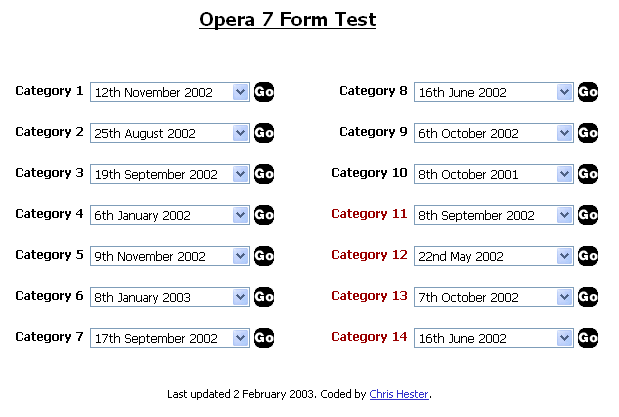
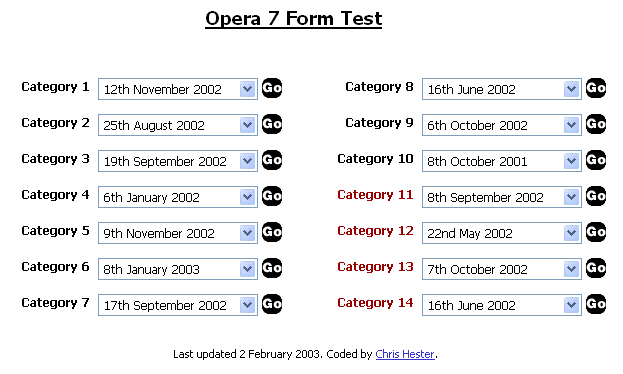
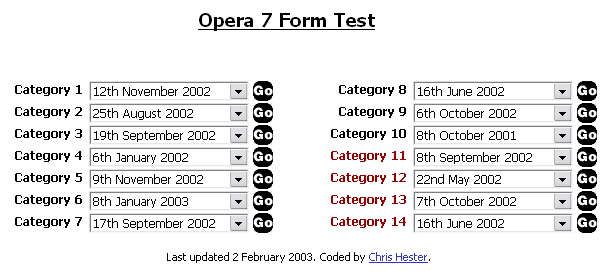
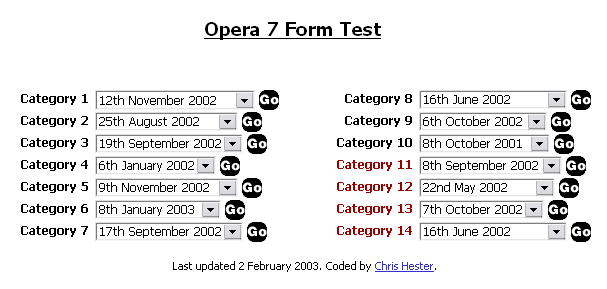
The drop-down menus should line up exactly to appear all the same width. But what I found was that Opera 7 on Windows 98 would show them ragged (lined up with the text inside not the specified width) and then would rearrange them all to be the same width. It took several seconds to do this, blowing away any claims that Opera 7 is the fastest browser.
Then I tried the test on Windows XP. Where the file was displayed offline, it would never match up the widths at all, leaving a ragged mess. I checked my code, but nothing I could do would fix it. So I uploaded the file and found online that it would sometimes align the menus, other times stop before all the menus were stretched to their proper widths. Only once did I manage to get the proper result, but refreshing the page resulted in differing widths.
Here is the page in question. Compare the screenshots taken from the following platforms:
- Internet Explorer 6, Windows XP
- Mozilla 1.1, Windows XP
- Opera 7 how it should look, Windows XP
- Opera 7 when it falls down, Windows XP
I'm not happy with the way Opera displays the menus too close together. So I tried using padding:5px; only to find Opera doesn't support padding on menu options!
The CSS2 Test Suite
Eric and Kathryn Meyer's Prototype CSS2 Test Suite is a useful place to find out which commands a browser company have implemented. I ran Opera 7 through the entire list and came up with these results (UPDATED 11th July 2003 based on Opera 7.11). As you can see, not all the commands are usable. This is true for the other main browsers on the market too. I still can't believe we can't stretch or compress fonts. 8-bit computers could! (If little else, besides bold and so on.) However, Opera 7 does pass a large amount of the tests, so it's a good start.
So what's new that's good?
Like the Mozilla browser, Opera 7 has some useful tricks it can perform if you're a web designer. But Opera goes beyond anything I've seen before. It allows you to test your web pages in a variety of ways. First off, you can view a page in the same way someone with a text-only browser might see it. Or emulate how it looks on a black and white monitor. In fact there are several 'accessibility' styles you can apply to a page. You can even mix and match them.
Some effects are genuinely useful for everyday browsing, such as blocking overly large images if you're on a slow connection. Or blocking all images on a page. You can hide any tables used in the layout, or show an outline around each part of the page. Best of all is probably the option to show the HTML tags around the relevant screen areas. It also tells you how many <FONT> tags and nested tables there are in a page.
Opera 7 also has a new 'small-screen' option that simulates a hand-held computer display. Great for seeing what your website looks like on very small screen sizes.
I like the idea of the 'Reload' feature. Right-click to set a page to reload itself as often as you like. So a news page might be reloaded every 30 minutes. You could keep it set all day!
One good point is Opera 7 allows you to prevent pop-up windows from occuring. No more surprise adverts!
There are many other new features or improvements, including a new mail program. For a full list, check the Opera home page. It might seem that with so many cool features, Opera is essential. This might be the case if it wasn't for the problems I found using it.
So what's new that's bad?
- The new page styles such as showing HTML tags on screen can stop working when moving between pages. Worse still, you can toggle CSS off then on, only to find it remains off! Or only parts of the page regain their styles. This never happened with Opera 6.
- Text-only mode has been reported to let in Flash!
- Switching to small-screen mode and back can leave you without CSS altogether. (The page appears in the basic colours and fonts set by the program, not the website.) I found there was no way to get out of this trap - switching CSS on or off made no difference.
- On some pages, pressing F11 to move to full-screen mode loses styles, including the background!
(UPDATE:) This is because Opera treats fullscreen mode as having a media type "projection" not "screen". To solve the problem, make your code similar to this:<link rel="stylesheet" href="styles.css" type="text/css" media="screen, projection" />(See next point though!)You can of course use different stylesheets for each mode. For more on this see this Opera forum page.
- (ADDED:) If I include a
<script>tag in the head of a document which has a separate link to stylesheets for screen and projection, it knocks out the projection style! I can't put the styles into one link (eg:media="screen, projection") because I just found out that kills the entire stylesheets in Netscape 4.The solution is to use a separate link to a stylesheet for
media="screen"and add the following code:<style type="text/css">@import url("projection.css") projection;</style>Then you can have a script tag in the head section too, and both Netscape 4 and Opera 7 are happy.
Note: It doesn't work if you link to the same stylesheet for screen and projection. Copy the file if the CSS is the same and give it a different name.
- The right-click menu for background images doesn't work. None of the options do anything.
- Switching from Print Preview to normal messes up text - spacings can differ. Text is either too far apart, or overlaps.
- Selecting "Print page background" doesn't do anything (in Print Preview mode).
- I used to like the old mouse gestures - drag the mouse left or right to go back or forward. But now you have to remember a sequence based on the right and left buttons. What if your mouse only has one button? Sorry, Apple users.
- Opera now suffers from the 'Flash of Unstyled Content' bug as described here. Although it handles the colours, it shows the wrong fonts before overriding them with the stylesheet.
- Clicking a link can sometimes make the characters move along the line slightly. Try the fake links in the menu on this page.
- By default, all links, including email addresses, now show up as tooltips when hovering over them. You can turn this effect off, otherwise it can make a mess of menus. It should be turned off by default.
- The 'Links' side menu misses off items on a page! Otherwise it's a nice way to see all the links on a page in one list.
(UPDATE:) Oddly, the links window gained by pressing CTRL + J doesn't miss any links. - PDFs don't open in the browser! You can probably change this, but why don't they open in Opera by default?
- Form
<fieldset>borders are shown! I saw boxes around all my forms. Even though I had applied the CSS codeborder:0px;to hide them. The solution is to make them the same colour as your background. (Unless you use a patterned background of course.) - Scrollbars and form buttons are grey. Opera uses its own designs for these elements, yet other browsers take the shape and colour from the operating system. You can change the 'skin' in Opera to use your computer's colours, but then it also recolours the whole of Opera, losing the new icons.
- On Windows XP, hovering over the browser icons reveals the text underneath, which zooms in. Move the mouse away, and the text zooms away to disappear. Yet on Windows 98, the text is there permanently. Surely the text should always be shown to aid users? Unless they choose to turn it off via the menu.
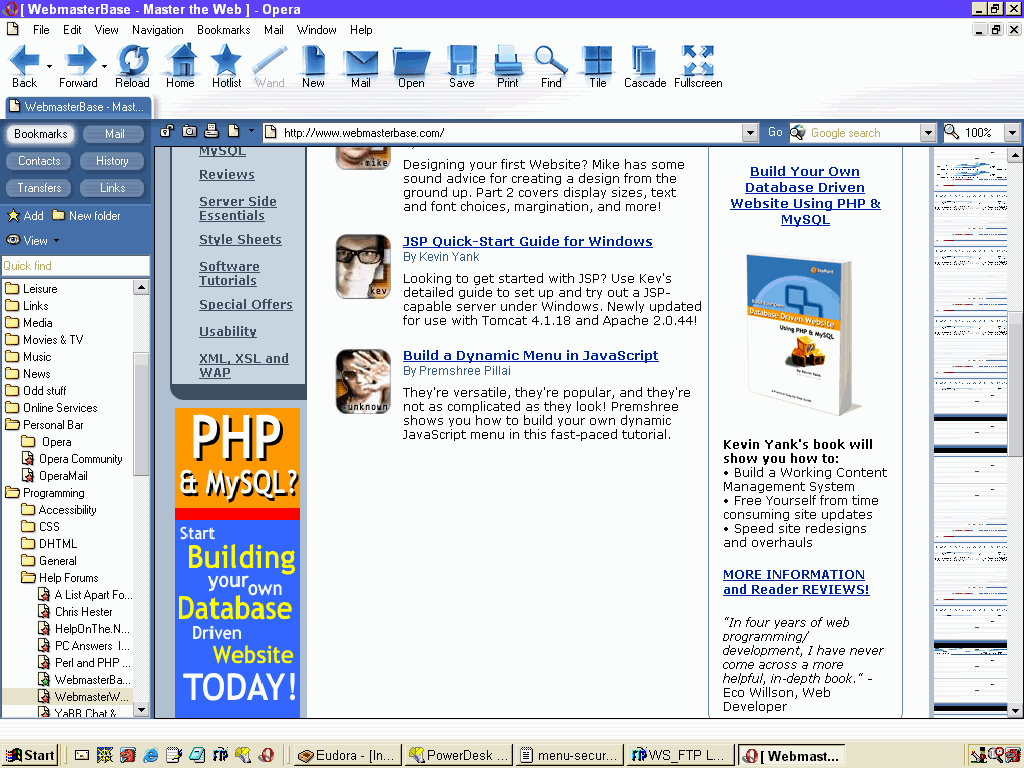
- I saw some terrible visual faults which I haven't been able to reproduce. It could be my computer was low on memory, but they should still never have happened. These include a bar down the right side when moving between pages, full of random lines of colour. It also happened going from small-screen mode to normal view. Then the sidebar buttons would have a black background speckled with garbage pixels. Scrolling the bar or dragging a bookmark also showed a corrupt display. Perhaps Opera doesn't like my graphics card? (It's a 32Mb TNT PCI.)
(UPDATE:) See screenshot. - I've also seen subtle flickering when hovering up and down the blank parts of a page with a lot of hover effects implemented. Very odd.
- Claims that Opera 7 is even faster than before must be taken with a pinch of salt. I found it to be slightly slower than Internet Explorer 6! Certainly not a big improvement over Opera 6 for speed either. Again, this might be just my system.
- Opera 7 still identifies itself to servers as "Internet Explorer" by default. WHY!? The reason before was to handle JavaScript that only worked in that browser, along with pages that 'sniffed' for browsers other than Opera. Yet one reason for releasing Opera 7 was to be able to cope now with these kind of pages. Yet I've found JavaScript that did not work with Opera. Plus other users have reported problems with Java. If a majority of users leave Opera set to be seen as Internet Explorer, it will show up as that browser in lists of the most-used browsers on the Internet. Hence it will continue to give a false impression that there are only a few Opera users! (Isn't that called shooting yourself in the foot?)
- Where is the option to avoid screen flicker by not clearing the screen between similar pages? This worked great in Opera 6. Now it appears to have been dropped.
- Other browsers allow you to navigate the links on a page using the TAB key. I couldn't find a way to do this in Opera 7.
(UPDATE:) I've found you can use A and Q, plus a host of other useful keys. - (ADDED:) Custom links are ignored on the page navigation bar, as this has a fixed row of titled buttons. There's no "More" button, which in Mozilla allows you to add to a page's navigation with extra sections. I copied the idea from the W3C homepage!
Example:
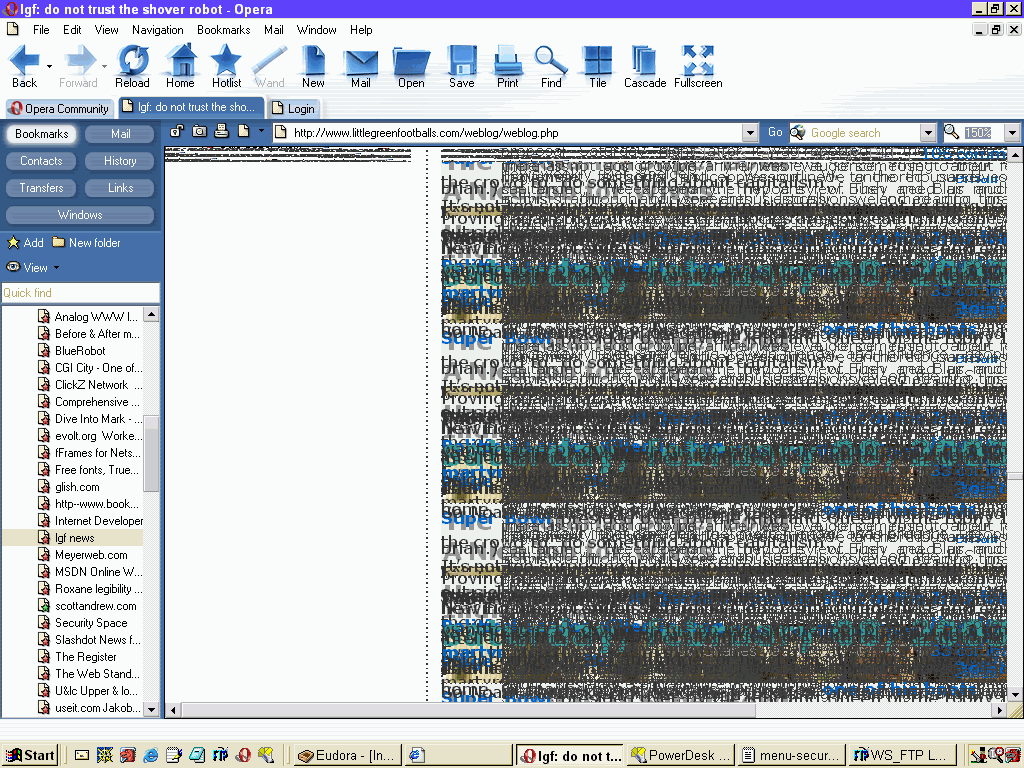
<link rel="Agreements" href="secure/filename.php" title="Sub Group" /> - (ADDED:) Ugh! On some sites if you zoom in to 120% or more, then scroll down, the screen fails to clear, leaving layers of text and graphics. See screenshot.
Conclusion
Opera 7 seems like a beta program given a final release ahead of schedule. Remember the fuss when Netscape 6 came out when it was still buggy? In my opinion, Opera 7 should not have been released as it stands. Or maybe the bugs are the kind that only come to light when a program leaves the labs and gets tested by a worldwide userbase? If so, I hope the next version of Opera will have tackled the problems it has now. There are some great features in there, and the Opera brand continues to have a loyal following. But for now, I'd recommend using it for testing pages only, or going back to Opera 6, or using another browser.
Further Reading
Evolt are running a lively review with user comments: Opera 7 Released
Eric Meyer has spotted a few bugs on his page.
(ADDED:) Plenty of users are listing the bugs they find on this thread on the Opera Forum.
Comments (9)
Comments are locked on this topic. Thanks to everyone who posted a comment.
I just installed Opera 7.2 and found out that it can't handle transparent backgrounds for flash files, (I used flash 5). What gives? I thought it might have been my scripting but i can't seem to remedy the problem. Please check out my site. It looks horrible on this browser but works great in IE, Netscape and Mozilla....haven't tested firebird yet.
Posted on 10th January 2004 at 3:31 pm 
There's something called 'wmode' (I think?) which the browser needs to support for Flash to get transparent backgrounds. I know someone else who came across the same problem - Opera just doesn't cooperate.
Not sure why - Flash is a major player so you'd have thought they'd want to be 100% compatible. Maybe Opera 7.5 has solved it?
Posted on 10th January 2004 at 10:02 pm 
I have just found this out also. For a while I thought it was my coding.
I am using Opera 7.21 on Win XP
For once it seems IE renders things better than Opera.
WMODE does not make any difference
Posted on 6th February 2004 at 5:56 am 
I just started using Opera last week. I find the program is very good. But there is one strange thing that happens.
If you look at my website under MS Internet Explorer my website is ok.
If you look at it with Opera it also look ok except fo one thing.
If you move down the page to a item that tell you the last time the Website was updated you will get a big suprise.
In MS exlporer it show the correct date. In Opera it shows the date to be 1970.
I do not know how to fix this problem or is it a problem with Opera?
My website: http://ronaldbubbly.100free.com
Thank You
Ron
Posted on 29th October 2004 at 12:23 pm 
How is the date generated? It must be with JavaScript, or the problem would affect all browsers, as usually the date is generated from the server. Opera does have problems with JavaScript, but these are being fixed as they release new versions. Sadly the latest version also shows the incorrect date. I will ask on the Opera support forums if anyone has a solution.
You might wish to change to a server-generated date. That way it'll be the same in IE6 and Opera. I can give you the code for this - but do you have PHP or ASP on your server? Most web hosts do these days. It's just a short line of code that can go anywhere on the page.
I tested your site in Firefox - yeuck! What went wrong there?
Posted on 29th October 2004 at 12:55 pm 
I was alble to fix the date problem with Opera 7 here below is code that works correctly and not in 1970 somewhere.
<p>
<SCRIPT LANGUAGE="JavaScript">
<!-- hide from old browsers
// get date object
var today = new Date();
var days = new Array('Sunday', 'Monday', 'Tuesday', 'Wednesday', 'Thursday', 'Friday', 'Saturday');
// write the date
document.write('<b>Last updated on: <b>');
document.write(today.toLocaleString());
// done hiding -->
</SCRIPT>
</p>
it can be jazzed up if anyone wants to play with it. If someone comes up with a better way to use this code send me an email.
Till Later
Ron Bubbly
Posted on 17th November 2004 at 4:03 pm 
cant there be a standart for browsers ?, naming conventions ?, unified names of css properties ?, standarts for javascript ?, or do these developers just intend to be incompatible wich means in my opinion that they want to produce a faulty product and driving webdesigners crazy?
Posted on 6th January 2005 at 7:53 am 
I am also having the same problem with Flash's wmode transparency... I am also using DHTML, and have tried putting the flash movie on one layer, and the navigation, links on layers on top... still no joy, Opera doesnt seem to recognise layers with flash movies either.
any help greatly appreciated.
you can see the problem on the homepage here...
http://www.kentech.ie/Kentech/NEW_index.html
The Navigation should have pop up selections like here:
http://www.kentech.ie/kentech/about_us/overview_eng.html
Posted on 17th January 2005 at 12:17 pm 
I believe Opera 8 supports Flash wmode. You can download the beta version now to test it.
http://www.opera.com
Posted on 17th January 2005 at 4:38 pm 